
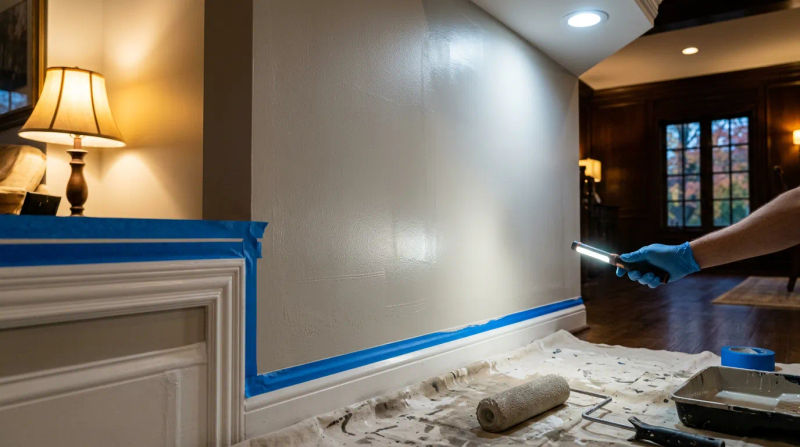
As a painter with over a decade of experience here in the Pittsburgh area, I’ve learned that the changing seasons reveal a lot about a home’s interior. Right now, in October, as the sun sets earlier and the beautiful fall leaves start to drop, you’re probably turning on your interior lights more often. You might be sitting in your living room, enjoying the cozy evening, when you glance at the wall and notice something you hadn’t seen all summer. Under the glow of a lamp, the paint finish looks… off. There are blotchy patches, maybe some faint stripes, or areas that look shinier than others.
What you're likely seeing is a common issue my team and I address all the time, especially in the grand, historic homes of Sewickley Heights. It’s called paint flashing, and it’s often accompanied by its cousin, roller marks. These imperfections are masters of disguise in the bright, diffuse light of summer, but they can’t hide from the low, angled light of lamps and the autumn sun. Let's break down what you're seeing and what it means for your walls.
Common Signs and Symptoms
Identifying these issues is all about looking at your walls from different angles and in different lighting conditions. The same wall that looks perfect in the morning might show its flaws in the evening. Here’s what to look for:
- Patches of Dull or Shiny Paint: This is the classic sign of paint flashing. It looks like the sheen of the paint is inconsistent. You might see a dull, flat-looking spot where a nail hole was patched, or a shiny area where the paint was applied a bit too heavily. These spots are most obvious when you look down a long wall or when light from a window or lamp rakes across the surface.
- Visible Lines or Streaks: If you can see the path the roller took, you’re looking at roller marks after painting. These can appear as distinct lines, often called “lap marks,” where one roller pass overlapped another that was already starting to dry. You might also see a texture difference that forms a striped pattern on the wall.
- “Picture Framing” or “Hatbanding”: This is a specific type of flashing where the edges of the wall, which were cut in with a brush, appear darker or have a different sheen than the main body of the wall that was rolled. It creates a subtle but noticeable “frame” effect around the perimeter.
- Uneven Color Perception: Sometimes, the issue isn't just the sheen but the color itself. An uneven sheen on walls can trick the eye into thinking the color is blotchy or inconsistent, even if it came from the same can. This is especially true with deeper, richer colors.
In Sewickley Heights, many of the pre-1940s estates have features that make these symptoms more pronounced. Two-story foyers, long hallways, and grand rooms with tall walls and multiple light sources create the perfect conditions for these subtle flaws to become glaringly obvious.
What Causes This Problem
Paint flashing and roller marks aren’t random. They are almost always the result of an issue with surface preparation or application technique. Understanding the cause is the first step to finding the right solution.
- Inadequate Surface Preparation: This is the number one culprit. Walls are rarely a perfectly uniform surface. Over the years, they accumulate repairs from nail holes, scuffs, or even larger drywall or plaster patches. These repaired areas have a different porosity and texture than the surrounding wall. If they aren't sealed with a quality primer before painting, they will absorb the new paint differently, causing the sheen to look dull or “flat.” The beautiful, older plaster walls in many local historic homes have seen decades of such repairs, making a proper priming step absolutely critical.
- Lack of Primer: Painting directly over a contractor-grade flat paint, new drywall, or a dark color without priming first can lead to inconsistent absorption and sheen. Primer is designed to create a uniform, sealed base so your topcoat looks smooth and even everywhere.
- Poor Painting Technique: Even with perfect prep, the way the paint is applied matters immensely.
- Losing the “Wet Edge”: When rolling a wall, it’s crucial to keep a wet edge, meaning you always overlap your new roller pass onto the previous one before it has a chance to dry. If the edge starts to dry, you’ll get those visible lap marks.
- Incorrect Roller Cover: Using a roller with the wrong nap (thickness) for your wall’s texture can lead to problems. Too short a nap won't apply enough paint, causing a thin, uneven coat. Too long a nap can create a heavy, stippled texture that looks unprofessional.
- Inconsistent Pressure: Applying too much or too little pressure with the roller can leave streaks and lines.
- Low-Quality Paint: Cheaper paints often contain fewer high-quality binders and pigments. This makes them more susceptible to flashing and less forgiving of minor imperfections in the wall or application.
When to Call a Professional
Once you’ve spotted these issues, the next question is whether you can fix them yourself or if it’s time to call for help. While the DIY spirit is admirable, correcting widespread finish issues is often more complex than it appears.
A small touch-up might seem easy, but trying to match the sheen and texture of the surrounding wall is notoriously difficult. Often, the “fix” just creates another noticeable patch, sometimes making the problem worse.
My advice is to call an experienced professional when:
- The Problem is Widespread: If you see flashing or roller marks across an entire wall or in a prominent room, a simple touch-up won’t work. The entire wall (or walls) will likely need to be properly prepared, primed, and repainted to achieve a uniform finish.
- You Have Challenging Architecture: Those beautiful tall walls in a foyer or great room are extremely difficult to paint correctly without the right equipment and technique. Maintaining a wet edge on a 20-foot wall requires speed, skill, and scaffolding - not just a roller on a long pole.
- The Walls are Old Plaster: Homes from the early 20th century have plaster walls that behave very differently from modern drywall. A qualified professional will understand how to properly clean, patch, and prime these surfaces to ensure a lasting, beautiful finish.
- You Need Guaranteed Results: If you’re looking for Sewickley Heights paint flashing help because you want the job done right the first time, a professional crew is your best bet. We have the experience, tools, and understanding of products to diagnose the root cause and apply the correct solution for a flawless finish that honors the character of your home.
Conclusion
Seeing paint flashing or roller marks after painting on your walls can be disheartening, especially in a home you take pride in. Remember that these issues are rarely a sign of a failing paint job, but rather an indication that the initial preparation or application wasn't quite right for the surface or lighting conditions. The low-angled light of fall and winter is simply revealing what was already there.
The good news is that these problems are entirely correctable. The key is to address the root cause - usually improper surface sealing - rather than just painting over it again. By ensuring the wall is properly primed and painted with professional technique, you can achieve the smooth, uniform, and beautiful finish your home deserves.
If you notice any of these signs on your walls, don’t hesitate to act. Contact a local Painting professional for an inspection. They can help you understand the scope of the issue and recommend the best path forward.